AI can produce an answer in seconds. But in high-stakes business processes, speed is only part of the equation.
The more important questions are often:
For organizations working with complex legal, financial, title, and transactional documents, those questions matter. That is why the next stage of enterprise AI is not simply about producing answers.
It is about producing trusted outcomes.
No responsible AI platform should promise that artificial intelligence is infallible. Even highly capable models can misinterpret information, miss context, or reach conclusions that require additional review.
And when something falls outside defined standards, it should be escalated appropriately. This is the thinking behind Aeon Reviewed.
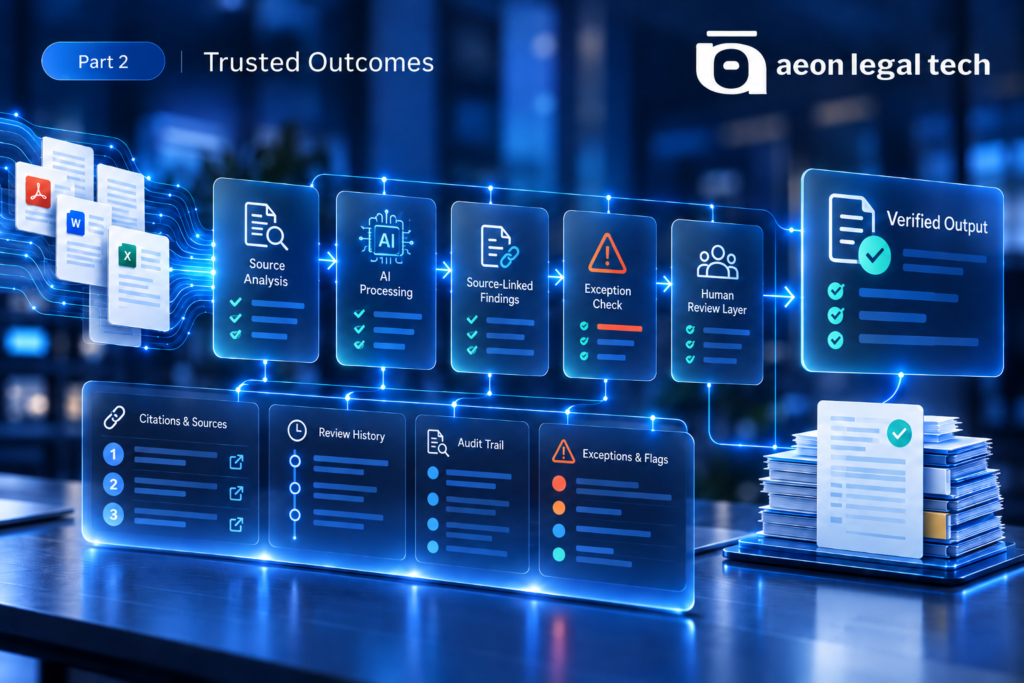
Rather than treating AI output as a black box, Aeon creates a structured review process that helps users understand what was analyzed, what was identified, and what still requires attention.
In operational environments, an answer becomes significantly more useful when someone can quickly verify it.
That can mean connecting findings back to source documents, identifying the information that drove a conclusion, highlighting exceptions, and providing a clear record of what was reviewed.
The goal is not simply to provide more information. It is to provide the right information in a form people can confidently act on. That also means avoiding another common problem with AI: overwhelming the user.
Instead of returning pages of unstructured analysis, Aeon can produce consistent, structured outputs designed around the decision or task that needs to be completed.
Trusted AI does not require blind confidence in the technology. In fact, the opposite is true. Organizations can have greater confidence when AI operates within defined controls, its outputs are transparent, and people have visibility into the areas that require judgment.
That creates a fundamentally different relationship with AI. The question moves from:
“Can we trust what the AI says?”
to:
“Can we understand how this result was produced, verify the important information, and know where attention is still required?”
For high-stakes work, that distinction matters. Trust does not come from claiming AI is always right. It comes from making the process transparent, controlled, and reviewable. That is the foundation of Trusted Outcomes.