
Much of the conversation around artificial intelligence focuses on what AI can understand. It can summarize a document, answer a question, extract information, draft content, identify patterns. All of these capabilities are valuable.
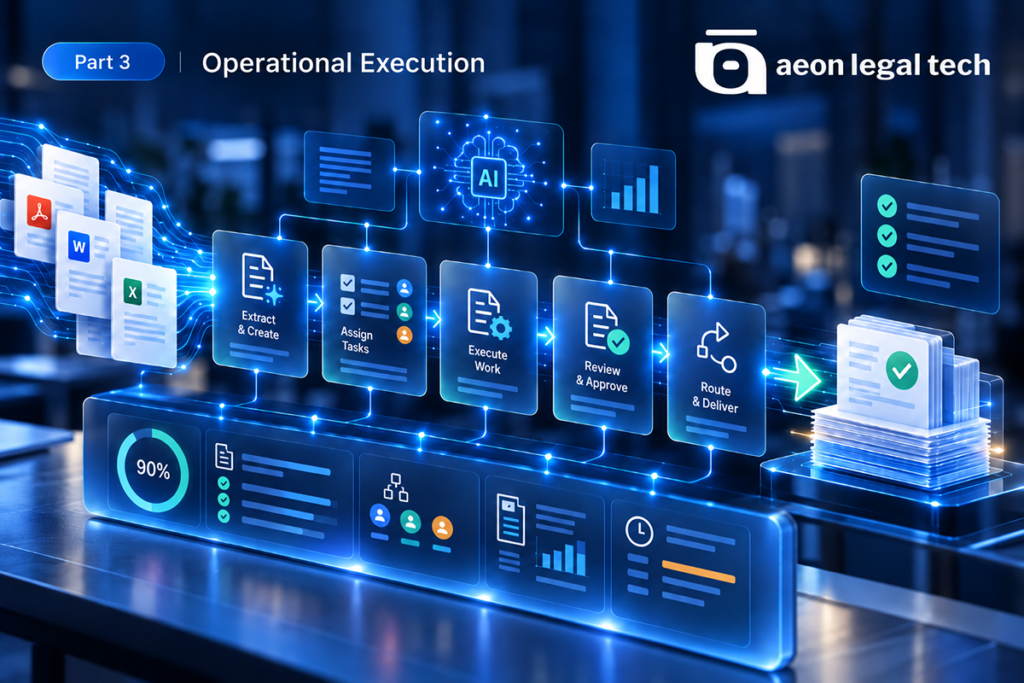
But for operational teams, understanding the information is often only the beginning. Someone still has to do something with it. That is where Operational Execution becomes important.
Consider the people responsible for moving complex transactions and business processes forward every day.
Their job is not simply to analyze documents. Their job is to complete a process accurately and efficiently.
That may require reviewing a package of documents, identifying missing information, applying company standards, resolving exceptions, creating structured work product, routing issues for review, and moving the transaction to its next stage.
AI can help with each of those activities. But the real value comes when those capabilities are connected together.
Operational users often do not need an AI system that asks, “What would you like to know?”
They already know what needs to happen. The process is defined. The challenge is completing it faster, more consistently, and with less manual effort.
Aeon can combine document intelligence, customer-specific context, structured workflows, and controlled review into a system designed around the work itself.
Instead of simply telling a user what is contained in a document, the system can help:
That moves AI beyond analysis. It becomes part of execution.
This distinction is especially important as organizations evaluate the growing number of AI tools entering the market.
General-purpose AI assistants can provide powerful capabilities. But high-stakes operational work often requires more structure. The technology needs to understand the process, the organization’s standards, the required output, and the controls surrounding the work. That is what allows AI to support repeatable execution at scale.
The goal is not to remove people from the process. It is to give them a better system for completing the work they are already responsible for.
The goal is not simply to understand the document. It is to help complete the work that the document drives.
That is Operational Execution.
And when Structured Intelligence, Trusted Outcomes, and Operational Execution come together, AI becomes something more than a productivity tool.
It becomes a system of execution for high-stakes, document-driven workflows.