
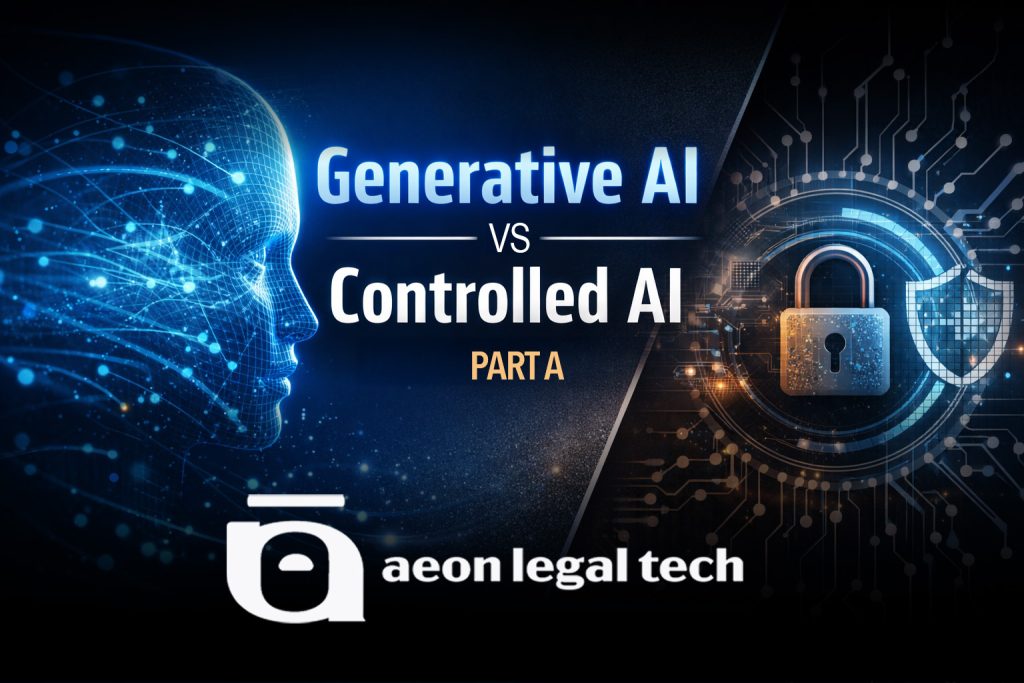
As VP and co-founder of Aeon, I spend a great deal of time speaking with general counsel, law firm partners, compliance leaders, and operations executives. Across industries, the conversation about AI has shifted. It is no longer, “Can it do this?” It is, “Can we trust it to do this safely, consistently, and defensibly?” The question has moved from capability to control. At Aeon, we believe the answer lies not only in what AI models are capable of, but in how they are configured.
Large language models are extraordinarily powerful. But in their default state, they are optimized for creativity, breadth, and conversational fluency. That is ideal for brainstorming, marketing copy, or ideation. It is not ideal for reviewing contracts, abstracting regulatory clauses, or generating legally operative documents.
What makes generative AI impressive in consumer use cases is often exactly what makes it risky in regulated environments.
In high-stakes domains like law, compliance, and finance, variability is risk. If a model produces slightly different outputs to the same input, or introduces creative extrapolations, that unpredictability can undermine internal controls, auditability, and ultimately client trust. Open-ended generation may be impressive, but in regulated environments, it must be constrained.
There is a misconception that safer AI means weaker AI. In reality, safety in enterprise contexts means controlled AI.
Discriminative AI systems used for fraud detection, document classification, or risk scoring have long been trusted because they operate within defined boundaries.
The next evolution of enterprise AI is not replacing that discipline, it’s bringing those same principles to generative systems.
At Aeon, we do not allow the model to behave like an open-ended chatbot when it is tasked with reviewing a purchase agreement or generating a compliance memo. Instead, we constrain its behavior so that it operates within well-defined parameters, producing structured, reproducible, and explainable outputs.
In other words, we transform a probabilistic language engine into a controlled legal workflow component.
So what does “controlled AI” actually look like in practice? At Aeon, governance doesn’t start with policies alone, it begins at the model level. The way an AI system is configured during inference directly shapes whether it behaves like an open-ended assistant or a disciplined enterprise tool.
The future of enterprise AI isn’t about making models more creative, it’s about making them more accountable.
In Part B, I’ll share how Aeon applies this philosophy at the model level to deliver deterministic, defensible outcomes.
Ryan Foster, Aeon Legal Tech