
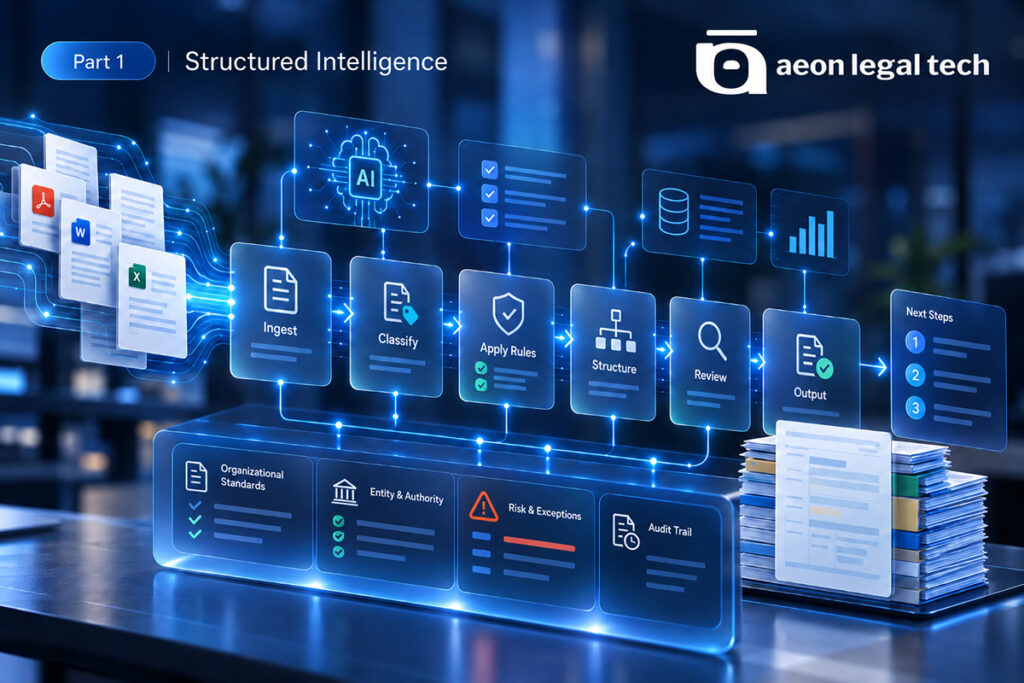
AI has become remarkably good at answering questions, summarizing documents, and generating content. But that does not necessarily mean it is built for operational work.
In banks, title companies, law firms, and other document-intensive organizations, much of the work follows defined processes. There are policies to apply, steps to complete, information to capture, exceptions to identify, and standards that must be followed consistently. The people performing that work are not necessarily looking for an open-ended AI assistant. They need technology that understands what needs to happen next.
That is the idea behind Structured Intelligence.
Rather than asking users to determine the right prompt every time they interact with AI, intelligence can be embedded directly into the workflow itself. That means the system can understand:
The intelligence becomes part of the process rather than a separate tool sitting beside it.
Operational processes are rarely identical from one organization to another. A bank may have its own credit policies, loan requirements, approval thresholds, and documentation standards. A title organization may have its own underwriting rules, production practices, and review requirements.
Structured Intelligence should reflect that context. Aeon can incorporate the organization’s own policies, requirements, standards, and business rules into the workflow so the technology is not simply analyzing information in isolation. It is analyzing information within the context of how the organization actually works.
Open-ended AI can be extremely powerful. But high-stakes operational work often requires something different: consistency.
The same type of transaction should be handled using the same standards. Important information should be presented in predictable ways. Exceptions should be surfaced clearly. And the process should not depend on each user remembering the perfect question to ask.
That is where structured workflows and structured outputs become important.
The goal is not simply to give employees access to AI. It is to build intelligence into the processes they already rely on.
The value of AI increases when intelligence is built into the process—not left for the user to figure out.
That is Structured Intelligence.
And it is one of the foundations for turning AI from an interesting tool into a reliable system for getting real work done.